
A long sleeve dress is one of the few pieces that works from a Tuesday meeting to a Saturday dinner, and it does so with very little else. That range depends on the dress itself. A well-made one holds its shape, moves with you and looks calm in every setting, while a poorly made one needs constant adjusting.
This guide covers how to style a long sleeve dress in ten ways, sorted by occasion. Before the styling, it covers how to judge the dress, because styling cannot fix a sleeve that pulls or a skirt that clings. The checks apply in a fitting room and, with some adjustments, from a product page.
What separates a well-made long sleeve dress from an expensive-looking one
An expensive-looking dress usually has a recognizable surface: a sheen, a logo, a dramatic silhouette, a price that signals something. A well-made dress holds up under inspection of the parts you do not see from across a room.
Four things carry most of the quality in a long sleeve dress: how the sleeve is built, how heavy the fabric is, how it falls, and whether it is lined. Each can be checked in a few minutes, and none of them requires knowing the price.
This matters most if you buy fewer pieces and wear them for years. A dress you will wear forty times earns scrutiny that a dress you will wear twice does not. Seams that strain at the first reach, a lining that rides up, or a fabric that bags at the elbow will show by the tenth wear.
Check the sleeve first: set-in seams, cuff finish and arm movement
The sleeve is where long sleeve dresses most often fail, because it has to fit a joint that moves in several directions.
The armhole seam. In a set-in sleeve, the sleeve is sewn into a curved armhole at the shoulder. Look at where the seam sits. It should fall at the edge of your shoulder bone, not down the upper arm and not up toward your neck. Run a finger along the seam on the inside: it should lie flat, without puckering, and the sleeve cap (the curved top of the sleeve) should look smooth on the outside.
Other constructions are fine when they are chosen deliberately. A raglan sleeve runs diagonally from underarm to neckline and is more forgiving of shoulder shape. A dolman or kimono sleeve is cut as one with the body and gives a softer line. The problem is a construction used to save fabric or fitting time, which shows up as drag lines across the chest or a sleeve that lifts the whole dress when you raise your arm.
The cuff finish. Look at the wrist. A good cuff is finished with a facing, a band, or a neatly turned and stitched hem, and it lies flat against the wrist or falls cleanly over it. If there is a vent or placket, the buttons should sit in proper buttonholes, and the thread should match the fabric.
Check the length too. A long sleeve should reach the wrist bone when your arm hangs at your side, and it should not climb past it when you bend your elbow. If it does, the sleeve is cut too short for the arm’s range of movement.
Arm movement. In the fitting room, do three things:
- Reach both arms forward as if to hold a steering wheel.
- Raise your arms overhead.
- Cross your arms in front of you.
If the back of the dress tightens across the shoulder blades, or the underarm digs in, the armhole is too low or too narrow for how people actually move. A sleeve that only works with your arms hanging still is a sleeve you will resent by mid-morning.
Fabric weight and drape: how to judge them in a fitting room or from a product page
Weight and drape are related but different. Weight is how heavy the fabric is. Drape is how it falls and folds when it hangs. A heavy fabric can drape well, as a good wool crepe does, and a light one can drape badly if it is stiff or if it is cut against the grain.
In a fitting room. Try these:
- The hang test. Hold a section of the skirt at the hem and let it fall. It should fall in soft, even folds, not stand away from the leg or cling in a wrinkled sheet.
- The crush test. Squeeze a handful of the fabric for five seconds and let go. Wool, good crepe and well-finished knits tend to release creases. Fabrics that hold the crush need steaming or ironing after every wear.
- The light test. Hold the fabric up to the light. If you can see the shape of your hand through it, you will need a lining or a slip, and the fabric may show every seam and undergarment line.
- The sit test. Sit down for a minute. A dress that rides up, pulls across the hips, or bunches behind the knees will do it all day.
Pay attention to what the fabric does at the elbow after you bend and straighten your arm. A little softening is normal. A bagged or creased patch that stays means the fabric lacks recovery, and it will look worse each time you wear it.
From a product page. You cannot touch the dress, so read what the page gives you:
- Check the fiber composition. Natural fibers such as wool, silk and cotton, and fibers like viscose and cupro, behave differently from polyester. Blends can work well, but the composition tells you what to expect for breathability and creasing.
- Look for a fabric weight if one is listed. When it is not, look at the product video or photos of the dress in motion, and notice whether the skirt swings in a single piece or flutters and clings.
- Read the care label. A dress that needs dry cleaning costs more to keep, which matters if you plan to wear it often.
- Check the return terms before you order, so you can run the fitting room tests at home.
Why lining matters more than most shoppers think
Lining is the detail most likely to be missing in a dress that looks good in photos. It does three jobs. It stops the outer fabric from clinging to your tights or skin. It protects the outer fabric from body oils and friction, which extends the life of the dress. And it gives the skirt a smooth line, so the hem hangs the way the designer intended.
Check the following:
- Coverage. A lined dress usually has lining in the body and skirt. Sleeves may be unlined, which is acceptable in a soft fabric and often more comfortable, but a heavier wool dress is easier to put on if the sleeves are lined and slide over a blouse.
- Fiber. A lining that breathes, such as cupro, viscose or silk, is more comfortable than one that traps heat and builds static. Rub your hand over it: it should feel smooth and a little cool, not slick and clinging.
- Hang. Turn the dress inside out. The lining should hang freely from the waist seam and end slightly above the outer hem. It should not be visible when you walk or sit.
- Seams. Look for finished edges on the seams. Raw, fraying edges inside a dress suggest that the maker saved effort in places where you would not look.
If the dress has no lining, you can wear a slip. That works, but it adds another layer to manage, so decide whether you want that daily.
Ways 1 to 4: dressing it for the office and daytime

A long sleeve dress already does much of the work in a professional setting, since the sleeves and skirt cover most of what a workplace asks to be covered. The styling goal is to give it structure.
1. Add a tailored blazer. Choose a blazer in a close but not matching color, such as camel over a navy dress. The blazer’s shoulder should sit just outside the dress’s shoulder seam, with enough room in the sleeve that the dress sleeve does not bunch at the upper arm. If it bunches, the dress sleeve is the wrong weight for layering and you should wear the dress alone.
2. Wear a long coat over it. A coat that ends at or below the dress hem makes one clean vertical line. If the coat is shorter than the dress, the hem layers look unplanned unless the difference is at least a few inches. Straight or slightly A-line coats suit most dresses; heavy, voluminous coats suit slim dresses best.
3. Choose low heels. A block heel or a kitten heel works well with a midi hemline, and it is comfortable enough for a full day of walking between meetings. Keep the shoe in a tone close to the tights or skin tone for the longest leg line.
4. Keep the accessories small. One watch, small earrings and a structured bag are enough. A long sleeve dress already fills the visual field from neck to wrist, and extra pieces compete with it.
Ways 5 to 7: evening and dinner

Evening dressing allows more contrast, but the dress should remain the main element.
5. Choose jewelry that matches the neckline. For a high neck, wear earrings and nothing at the throat; a necklace fights the collar. For a V or scoop neck, a short pendant or a fine chain follows the neckline’s shape. For a boat neck, statement earrings or a cuff bracelet over the sleeve work better than a necklace.
6. Carry a sharp clutch. A structured clutch in leather or satin, in a metal tone that matches your jewelry, gives the outfit a clean edge. Soft, slouchy bags suit daytime and weaken a dressed-up look. Choose a size that holds your phone, a card and a lipstick, and nothing larger.
7. Pick the right shoe for the hem. With a midi skirt, a pointed pump or a slim strappy sandal lengthens the leg. With a floor-length hem, wear a heel high enough that the hem clears the floor when you walk, since a dragging hem frays and looks careless. For a mini length with long sleeves, an ankle boot in a matching color keeps the proportions balanced.
Ways 8 to 10: weekend and travel

Casual settings need fewer parts and more comfort.
8. Wear flat boots. Knee-high flat boots with a midi dress leave a small, deliberate gap of skin or tights between hem and boot top, or no gap at all if the boot is tall enough. Both work. A hem that stops just at the boot top and creates an awkward line at the calf is the version to avoid.
9. Layer a knit. A fine-gauge cardigan or a thin sweater worn over the shoulders or open in front adds warmth without bulk. Pick a knit in a similar fiber weight to the dress; a chunky knit over a thin dress overwhelms it. A knit that you can pack flat suits travel particularly well.
10. Add a belt. A belt at the natural waist defines a shape in a dress that otherwise falls straight. Use a slim leather belt with a plain buckle. On a dress with a seam at the waist, place the belt over the seam so it does not create a second line.
For travel, a dress in a fabric that releases creases, with a lining that does not cling, will arrive in better shape than one that needs pressing. Roll it rather than folding it sharply, and hang it in a steamy bathroom if it needs freshening.
Matching the dress to your proportions: length, neckline and waist placement
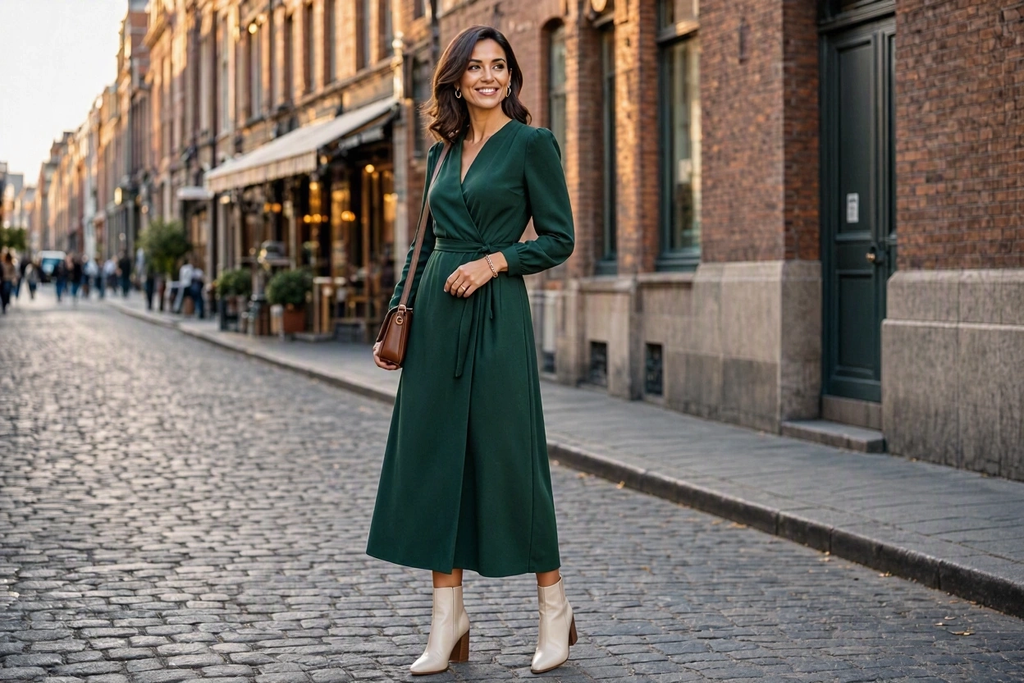
Proportion decides how a dress looks on you more than the dress’s price or label does. Three measurements matter.
Length. Hem position changes how your leg line reads. A hem just below the knee suits most heights and works with both flats and heels. A mid-calf hem lengthens a taller frame but can shorten a shorter one unless you wear a heel or a pointed shoe. A hem at the ankle or floor suits a taller frame, or anyone wearing a heel with it.
Neckline. A high neckline draws the eye up and suits longer necks or anyone who wants a streamlined look. A V-neck lengthens the torso and suits shorter necks or a fuller bust. A boat neck widens the shoulders and balances wider hips. A square neck frames the collarbones and suits those with narrower shoulders.
Waist placement. Look at where the waist seam sits relative to your natural waist, which is the narrowest part of your torso. A seam that sits above it shortens the torso and lengthens the legs. A seam that sits below it does the reverse. A dress with no waist seam, such as a shift or column, relies on the cut and drape, so the fabric weight matters even more.
When in doubt, try the dress with and without a belt. If the dress looks right only with the belt, the waist is not in the right place for your body, and a tailor can sometimes move it.
A short checklist to carry when you shop
Keep this on your phone and run it before you buy:
- Shoulder seam: sits at the edge of the shoulder bone, with no pulling or puckering.
- Sleeve length: reaches the wrist bone and stays there when the elbow bends.
- Arm movement: no tightness when reaching forward, overhead or across the body.
- Cuff: neatly finished, with real buttonholes if there are buttons.
- Fabric: soft, even folds when hung; creases release after a squeeze.
- Opacity: not see-through in natural light, or lined to prevent it.
- Lining: smooth, breathable, hangs freely and ends above the outer hem.
- Seams inside: finished edges, no loose threads.
- Proportions: hem, neckline and waist seam sit where they suit your frame.
- Care: you are willing to follow the care label for years.
A dress that passes these checks will serve you in every setting above, with minor changes in shoes, layers and accessories. Spend the effort on the dress, and the styling becomes straightforward.