
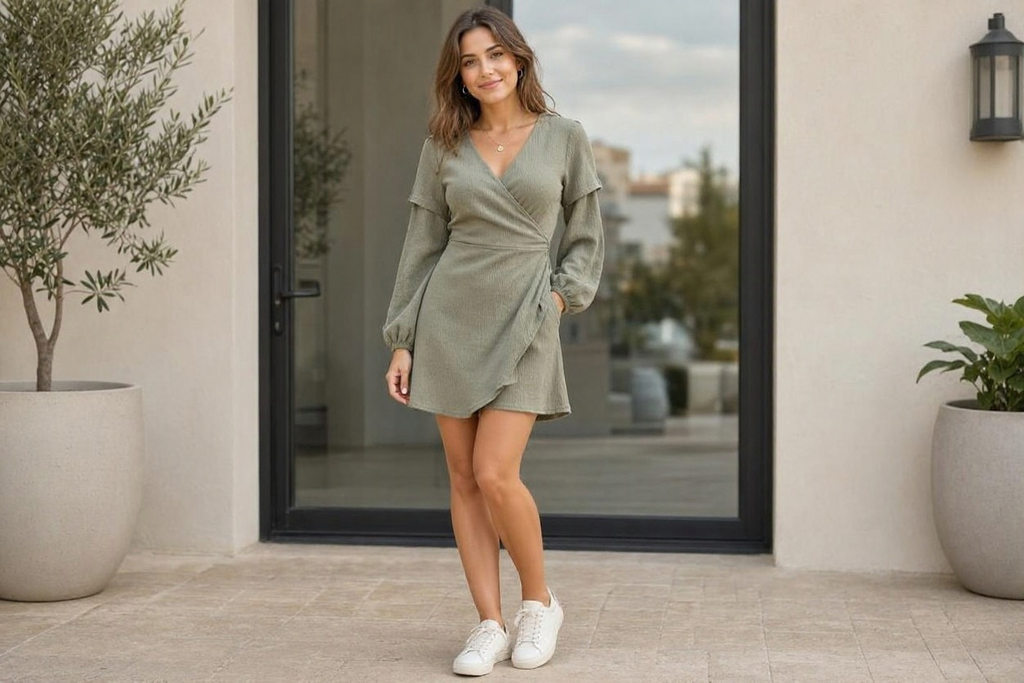
Short long sleeve dresses carry a lot of the work of an outfit: with the sleeves covering the arms and the hem above the knee, the dress needs no extra layers. The twelve below are chosen by construction and fabric, not price, so each entry shows you what to look for as well as what to buy. A dress that looks expensive usually has the same few things going for it, and you can check them in a fitting room in under a minute.
What makes a short dress look expensive

Fabric weight comes first. A fabric with some heft hangs straight, skims the body and keeps its shape after a day of sitting. Thin, clingy fabric shows every seam and every line underneath, and it creases at the hip and elbow.
Neckline and sleeve construction come next. A clean neckline that lies flat against the collarbone looks considered. A sleeve that is set into the armhole with a smooth curve, and that ends exactly at the wrist bone, looks tailored. Sleeves that twist, ride up or bunch at the elbow are the quickest way a dress looks cheap.
Then there is the finish: seams that lie flat, a hem that hangs evenly, a lining that moves with the outer fabric, and a zip that disappears. Color matters too. Solid, saturated or neutral shades read as more costly than busy prints, mostly because they show off the cut and the cloth.
With a short hem, the proportions have to be right. The hem should fall at a consistent point on the thigh, the shoulders should sit on your shoulders, and the waist seam, if there is one, should land where your waist is.
The quiet classics: crepe, satin and ponte minis

These are the dresses to build a wardrobe around. They have little ornament, so the cloth and the cut do all the work.
1. The crepe shift. A mid-weight crepe has a slightly pebbled surface that absorbs light instead of reflecting it, which gives a matte, even look. A shift cut with bust darts and a straight line to the hem works in black, navy, chocolate or ivory. Look for a set-in sleeve with a small cuff or a clean hem, and a high, round neckline.
2. The satin mini with a cowl or boat neck. Satin looks costly when it is heavy enough to drape and cut on the bias or with enough ease to fall in soft folds. Thin satin that clings shows every line and creases at the seat. A boat neckline keeps the dress modest on top so the sheen has somewhere to go. Deep colors such as bottle green, wine and midnight blue hold up better than pale ones.
3. The ponte fit-and-flare. Ponte is a thick, stable double knit, which means it holds a fitted bodice without clinging and a flared skirt without collapsing. It resists wrinkles, so it suits travel and long workdays. A seam at the waist and a skirt with a gentle flare give structure. Pick a ponte with a smooth face and no visible pilling at the seams.
4. The crepe wrap. A wrap dress in crepe with a faux or true wrap closing shapes the waist and adjusts to small fit differences. The details to check are a wrap that stays closed when you sit, a neckline that does not gape, and a tie or hidden snap that is placed neatly. In a short length, a true wrap needs an inner fastening so the skirt does not open when you walk.
Textured and tailored: tweed, bouclé and structured knits
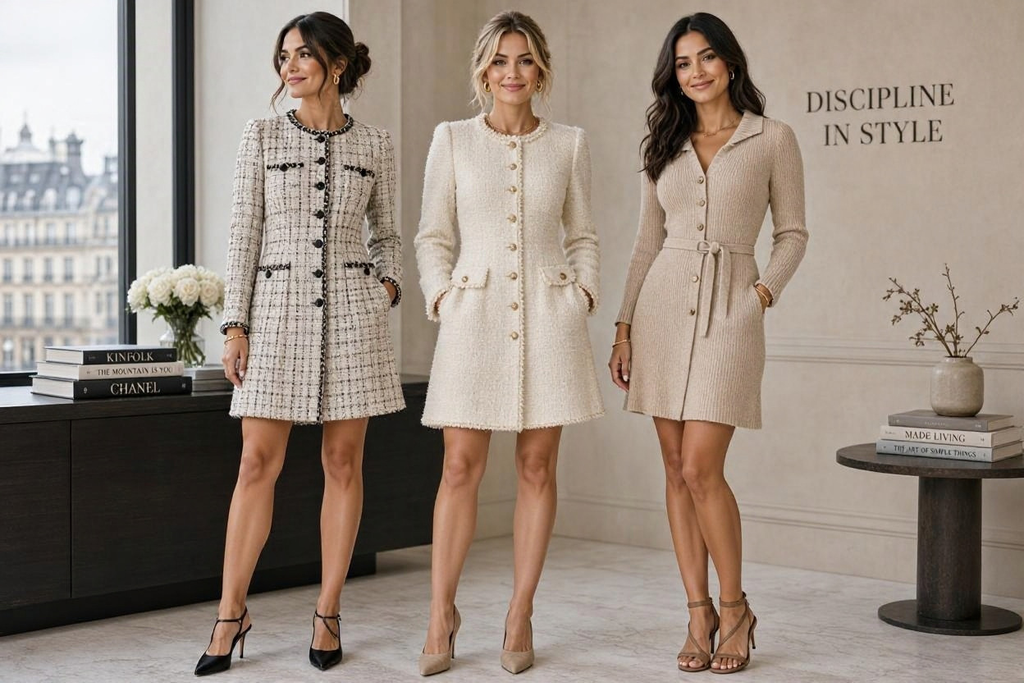
Texture adds visual interest without color or print, and structured fabrics give a dress the stiffness of a jacket.
5. The tweed jacket dress. A woven tweed with a slight fleck in two or three tones looks like tailoring. The most important sign of quality is a lining that is fully finished, so no raw edges show inside. Pattern matching at the seams, where the weave lines up across the center front and the side seams, is a strong marker of careful cutting. Buttons should be sewn on firmly, with a shank or thread that lets them sit slightly above the fabric.
6. The bouclé shift. The looped yarn gives the surface a soft, nubbly look. Bouclé works best in a simple shape, a round neck and a straight or slightly A-line skirt, because the texture is already doing the decorating. Check the inside for a lining, since bouclé can be scratchy and can stretch over time without one. Snags show on loose weaves, so avoid anything with pulled threads at the shoulders or cuffs.
7. The fine-gauge knit sweater dress. A knit in merino or a similar fine yarn, with a close, even stitch, looks refined when it has structure at the neck and cuffs. Look for ribbed trims that spring back when stretched, and a body fabric thick enough that it does not cling. In a short length, a straight knit with a mock or crew neck reads as polished rather than casual.
8. The blazer dress. Peaked or notched lapels, a single or double-breasted front and padded or lightly structured shoulders turn a short dress into a tailored piece. It needs a defined waist, either with a belt or with seaming, and a hem that does not ride up when you sit. Check that the front closure lies flat when it is fastened.
Evening edit: velvet, sequins and sculpted sleeves

For evening, richer surfaces take over, and construction matters even more because the fabrics are less forgiving.
9. The velvet mini with a square neck. Silk velvet or a good-quality stretch velvet has a dense, even pile that changes shade as it moves. A square or scooped neckline frames the collarbone and gives the dark pile a clean edge. Run your hand against the nap: the pile should bounce back and not leave a permanent mark. Jewel tones such as emerald, sapphire and burgundy look the richest.
10. The sequin column. Sequins look costly when they are sewn densely and evenly, lie flat and are backed by a full lining. Sparse or loosely attached sequins shed and look dull. A simple shape, with a high neck and long sleeves, keeps the sparkle controlled. Matte sequins or small paillettes in champagne, gunmetal or black read as more refined than large mirrored discs.
11. The sculpted-sleeve crepe dress. Here the sleeve is the feature: a structured puff at the shoulder, a bell or a gathered cuff. The sleeve should keep its shape without drooping, which usually means a sturdier crepe, a light interlining or a carefully set head. The body of the dress should be plain so the sleeve stands out.
12. The sheer-sleeve dress with an opaque body. A mesh, organza or chiffon sleeve over a solid bodice and skirt gives evening drama while keeping the short hem modest. Check that the sleeve joins the body with a clean, narrow seam and that the cuff has a finished edge or a covered button. The sheer fabric should be lightweight but not flimsy, with no visible puckering at the seams.
How to read the details: seams, lining, hems and buttons
Turn the dress inside out before you buy it.
- Seams: They should lie flat and be finished with a clean overlock, a binding or a French seam. Loose threads, puckering or uneven stitching suggest rushed construction.
- Lining: A lining that is cut to the same shape as the dress and hangs freely from the hem is a good sign. A lining that is shorter than the skirt, or that clings to the outer fabric, is a problem.
- Hems: A hem should hang level all the way around. Hold the dress up and look for dips, which show uneven stitching or fabric that has stretched. A narrow, blind-stitched hem usually looks finer than a thick topstitched one.
- Sleeves and cuffs: Raise your arms and bend your elbows. The sleeve should move with you, and the body of the dress should not lift. Cuffs should be securely finished, and buttons should be sewn with a reinforced thread.
- Zips and closures: A concealed zip should lie flat, and the fabric around it should not ripple. A hook and eye above the zip takes the strain off it.
Shoes, jewelry and outerwear that finish the look
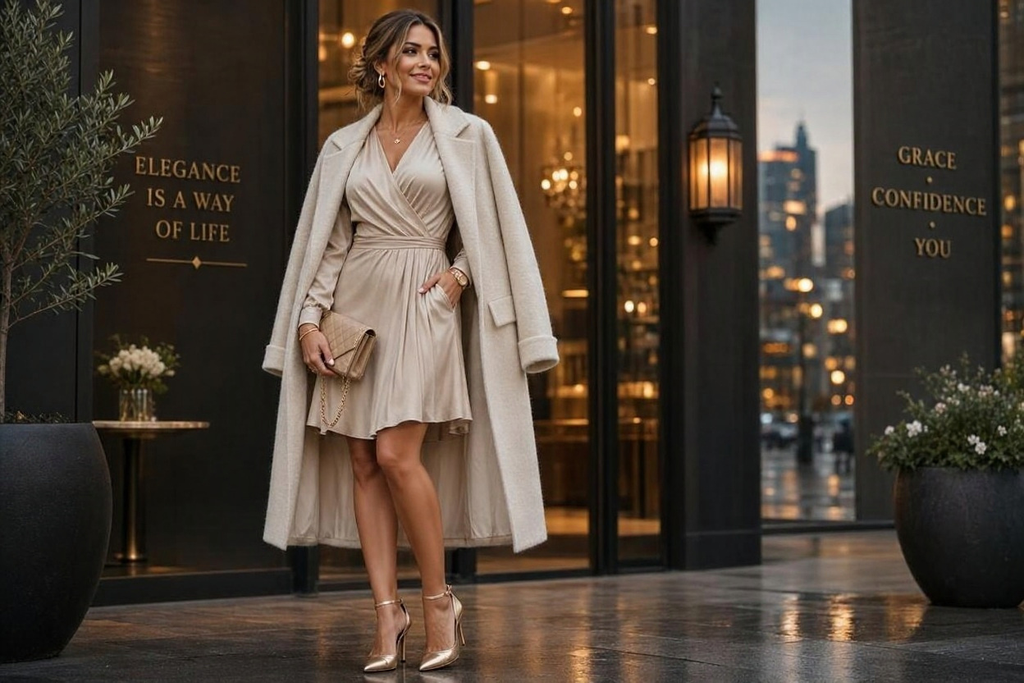
A short dress with long sleeves leaves the legs and the neck and wrists as the main places to finish an outfit. Keep the dress as the main event and choose the rest to support it.
For shoes, a pointed-toe pump, a sleek ankle boot or a polished loafer in a leather that matches your bag works across most of the twelve. Sheer or skin-tone tights in a matte finish smooth the leg line, and opaque black tights suit the velvet, tweed and knit options.
For jewelry, choose one focus. Small earrings and a slim watch suit a high neckline, while a longer pendant or statement earrings work with a boat or square neck. With sequins and sculpted sleeves, wear less, since the dress already provides the detail.
For outerwear, a coat that is longer than the dress, such as a belted wool coat or a straight trench, finishes the proportions. Cropped jackets compete with the hem of a short dress. Choose a coat with a collar and shoulders cut for the dress’s sleeves so the sleeves do not bunch inside.
Care and fit notes to keep each dress looking new
Read the care label before the first wear. Crepe, ponte and knit dresses often benefit from gentle washing or dry cleaning, depending on the fiber content. Velvet, sequins, tweed and bouclé generally do better with dry cleaning, and any dress with a lining or structure should not be tumble dried.
Hang structured dresses on a padded or wide-shouldered hanger and fold knits flat to avoid stretching at the shoulders. Store velvet hanging, not folded, so the pile does not crush. Use a steamer, not a hot iron, on satin and crepe, and steam velvet from the reverse side. Keep sequined dresses turned inside out when you store them so the surface does not snag.
For fit, the most useful checks are shoulder seams that sit at the edge of your shoulders, sleeves that reach the wrist bone, and a hem that lets you sit and bend without adjusting. Tailoring a sleeve or hem is usually simple, while changing the shoulder or bust line is much harder, so choose the size that fits the upper body and have the rest altered.